
How Do Arctic Animals Stay Warm?
In this activity, you will
head to the kitchen and pretend to be a walrus or a polar bear to answer the question: how do Arctic animals stay warm in the most frigid, freezing conditions on Earth?
Supplies Required
- Bowl full of ice water
- Shortening
- Rubber glove



The Challenge
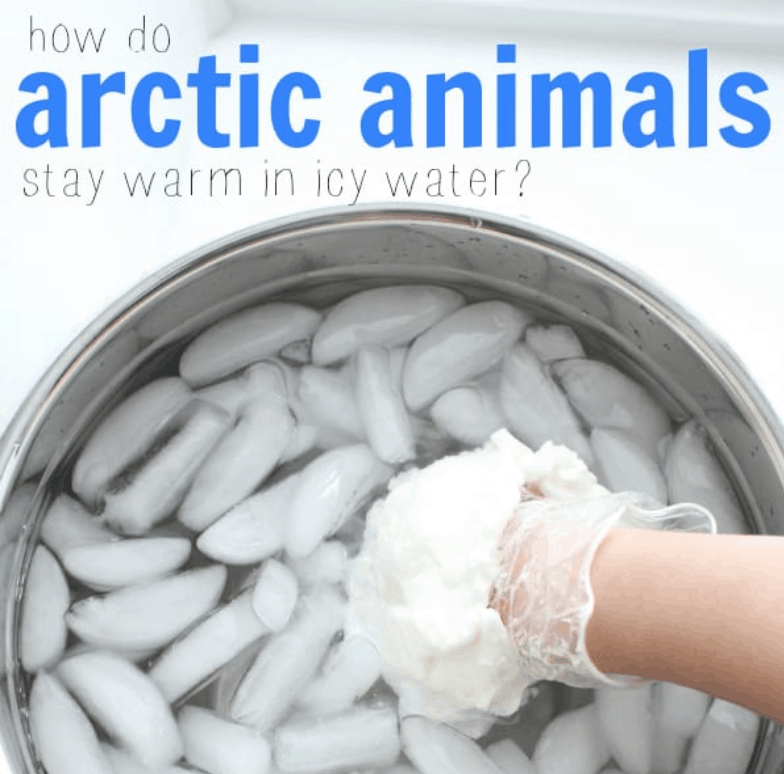
Shortening is made of fat. In this experiment, it simulates the layer of blubber that Arctic animals, like seals, whales, walruses, and polar bears, have on their bodies to insulate them from the cold. It makes a huge difference, doesn’t it?
Problem and Hypothesis
[contact-form-7 id="18628" title="STEM book form SCI 1"]Let’s Experiment and Build!
Instructions
- Place a bare finger in the bowl of ice water. Count how many seconds you can stand to leave it there before it gets too cold.
- Pull your finger out and warm it up.
- Get some help to coat one finger with a thick layer of shortening. Be sure that no skin is visible.
- Place the shortening-covered finger in the ice water and measure how long you can leave it there now.
- Make some observations: Could you feel the cold water through the layer of shortening? How long did you leave your finger in the ice water?
Experiment, Analysis, and Conclusion
[contact-form-7 id="18626" title="STEM book form SCI 2"]Think about it and Additional Resources
Now Try This! Try coating a finger with other substances to see if it insulates like shortening does. Be sure to measure how long you can leave your finger in the ice water each time and keep track of the results. Some ideas to try include peanut butter, butter, a piece of bread, and whipped cream.
Share on social media: Record a video or take a picture of your activity
and post the results online using the hashtags:
#ArcticAnimals
#ProjectExploration
#StemAtHome
Tag a friend and challenge them to do it, too!
For more activities like this one, go to www.projectexploration.org/stemhome. If you’re interested in learning more about Project Exploration and our free events, programs, and activities, please find us on social media and be sure to follow!
Call or text us for help: 312-772-6634
In these videos, you’ll learn:
- about animal adaptations
- about the big freeze